When you’re working toward health or fitness goals, it’s easy for you to get caught up in the number on the bathroom scale. But that number alone doesn’t tell the full story. It can’t show how much of your weight comes from muscle, fat, water, or bone, and each of those plays a very different role in how your body looks, feels, and functions.
As a dietitian, one of the first things I tell my clients is to stop letting the bathroom scale run the show. That number is just one data point, and honestly, it’s not even a very useful one on its own. Two people can weigh the exact same amount and look and feel totally different, because weight alone doesn’t capture what’s actually happening underneath.
I’m not just telling you this from a textbook, I’m living it right now. I had a breast reduction on August 13th, and I still haven’t been released to exercise, six weeks later. The scale actually shows I’m down 5 pounds. Sounds great, right? Except I know that’s not fat loss, that’s muscle loss. I can feel it: my clothes fit tighter in places even though the scale is lower, I’ve lost tone I’ve worked hard for, and my body simply doesn’t feel like mine right now.
If I were only looking at the scale, I’d think I was doing great. But I know better, because I know what’s actually happening underneath that number. This is exactly why I don’t let my clients obsess over the scale either. It can drop for reasons that have nothing to do with getting healthier, just like it can stay flat or rise for reasons that mean you’re doing everything right.
I’m hoping to get released soon and get back to training. And when I do, don’t be surprised if I tell you the scale barely moves for a while, even as I rebuild the muscle I’ve lost. That’ll be a win, not a setback.
Does Muscle Weigh More Than Fat?
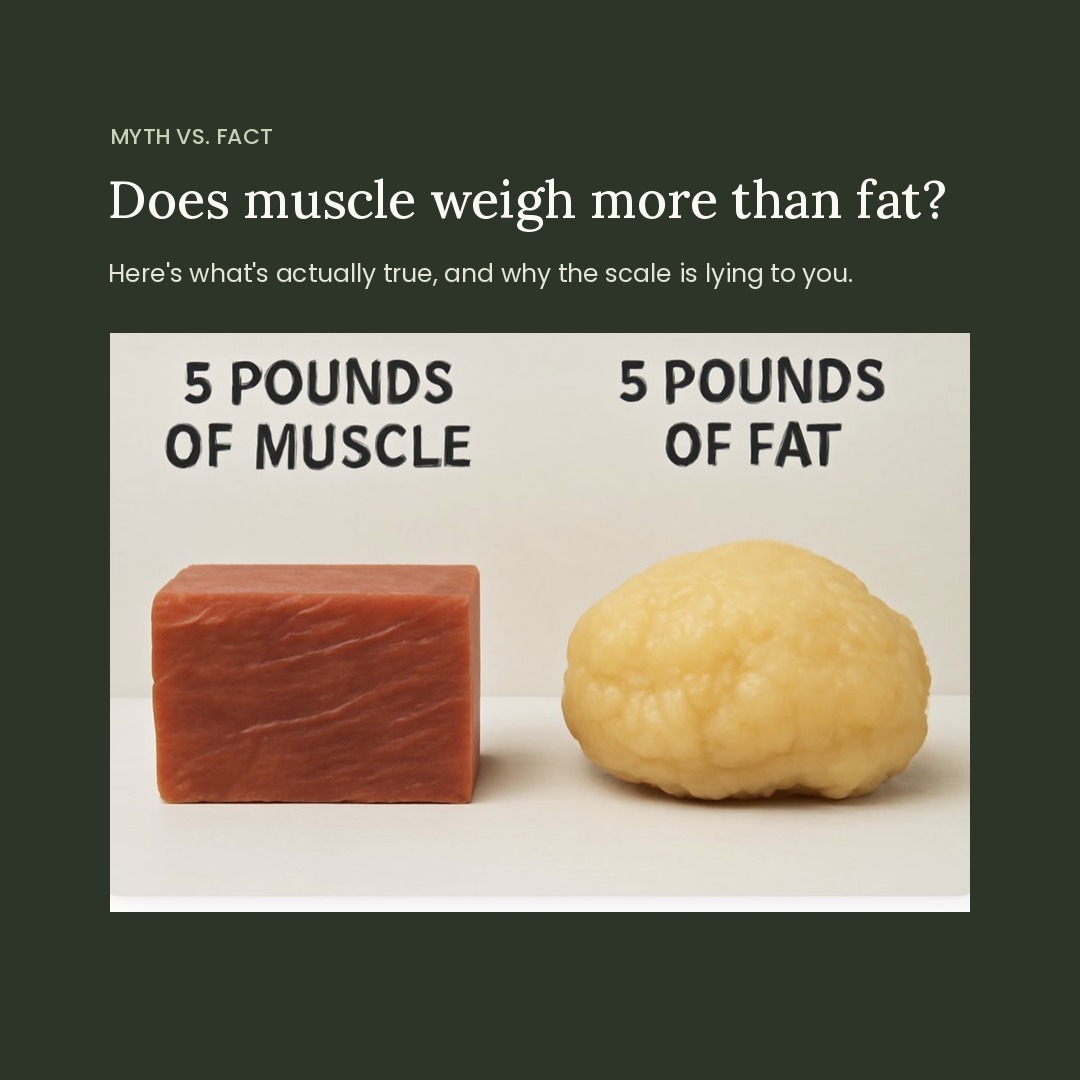
I hear this one all the time, and I get why: “muscle weighs more than fat” sounds like it should be true. But here’s the reality a pound is a pound. One pound of muscle and one pound of fat sit on a scale exactly the same. What actually differs is density.
Muscle packs in roughly 18% more density than fat. Research published in the American Journal of Clinical Nutrition puts lean tissue density around 1.1 g/cm³, compared to about 0.9 g/cm³ for fat tissue. In practical terms, that means a pound of muscle takes up noticeably less room in your body than a pound of fat.
I like to explain it to clients this way: picture a pound of muscle as roughly the size of a deck of cards, and a pound of fat as closer to the size of a tennis ball. Same weight, very different footprint. That’s exactly why two people can be the same height and the same weight on the scale, yet look completely different, one leaner and more defined, the other softer. Body composition, not body weight, is telling that story.
So here’s what I tell every client who starts strength training and sees the scale stall (or even creep up a little): don’t panic. That often means you’re losing fat and gaining muscle at the same time, and since muscle is denser and more compact, your body can be changing shape and composition even when the number on the scale barely moves. That’s not your plan failing, that’s often a sign it’s working exactly as it should.
How Muscle Affects Your Weight
Here’s something I see all the time: a client starts strength training, they’re eating well, and then the scale ticks up a little. Cue the panic texts. But I always tell them, take a breath, because this is usually a really good sign, not a bad one. Here’s what’s actually going on underneath that number.
Muscle repair. When you strength train, you’re creating tiny amounts of damage in your muscle fibers, and your body responds by rebuilding them stronger. That repair process, called muscle protein synthesis, doesn’t stop when your workout ends. Research shows it can stay elevated for up to 48 hours after a single session.
Water and glycogen. As your muscles adapt to training, they get better at storing glycogen, the carb fuel your muscles use for energy. Every gram of glycogen you store pulls in about 3 grams of water with it. That’s extra weight on the scale, but it’s not fat, it’s fuel and hydration your muscles are holding onto so they can perform better.
Bone density. Resistance training doesn’t just build muscle, it strengthens your bones too. That added bone density shows up as a small amount of extra weight, but it’s protecting you for decades down the road.
Your metabolism. This is the one I love explaining, because it’s genuinely motivating. Muscle tissue burns roughly 7 to 10 calories per pound just sitting there at rest, compared to only 2 to 3 calories per pound for fat tissue. Gain just 3 pounds of muscle and you can boost your resting metabolism by about 7%.
Here’s the example I give clients constantly: say you lose 5 pounds of fat and gain 5 pounds of muscle over the course of your program. Your scale weight doesn’t budge. But your body has changed dramatically, you’re more toned, your clothes fit differently, and your metabolic health markers have actually improved. The scale stayed silent, but your body did not.
Physical Indicators It’s Muscle, Not Fat
You don’t need fancy equipment to notice when your body composition is actually shifting. Some of the clearest signs show up in the mirror and in daily life, not on the scale:
- More visible muscle definition and smaller circumference measurements, even if the scale hasn’t moved much
- Clothes fitting differently, especially around the waist, hips, and thighs
- Feeling noticeably stronger and having more endurance during workouts or everyday activities
- Bouncing back faster between workouts instead of feeling wiped out for days
Functional Improvements
The changes I care about most as a dietitian aren’t just visual, they’re how you actually feel day to day. When body composition improves, clients almost always tell me:
- Their energy is steadier throughout the day, no more 3pm crashes
- Everyday tasks and workouts feel easier
- Their posture and the way they move improves
- They’re sleeping better and recovering faster
This is exactly why I push my clients to look beyond the scale and track real body composition data instead of guessing. That data tells us what’s actually working, so we can adjust your nutrition and training based on facts, not frustration.
Nutritional Strategies for Building Muscle
This is where nutrition and training really come together, and it’s the part of my job I love most. Here’s what I focus on with clients who want to build or preserve muscle:
Protein intake. Research points to 1.6 to 2.2 grams of protein per kilogram of body weight daily to support muscle protein synthesis, even while you’re in a fat loss phase. Lean meats, dairy, eggs, legumes, and the occasional shake all count toward that number, so we build a plan around what you’ll actually enjoy eating.
Energy balance. If you want to lose fat without losing the muscle you’re working so hard to build, I keep it simple: eat about 10 to 20% fewer calories than you burn, not drastically less. Extreme dieting backfires, it slows your metabolism and cannibalizes muscle right along with the fat.
Nutrient timing. Getting protein in around your workouts can give muscle protein synthesis and recovery a bit of a boost. But I don’t want clients getting obsessive about timing it perfectly. What you eat across the whole day matters far more.
Hydration. This one gets overlooked constantly, but I bring it up with every client. Being dehydrated hurts your performance, slows your recovery, and can even impair muscle protein synthesis. Don’t just chug water at the gym, sip on it consistently all day long.
Key Takeaways
- Muscle and fat weigh exactly the same, pound for pound. What sets them apart is density, muscle is about 18% denser than fat
- The number on the scale alone doesn’t tell you much about your actual health or fitness progress
- Your body composition, the ratio of fat to lean mass, matters far more than your total weight
- How you look, how you move, and your health markers are all better progress indicators than the scale
- Building muscle while losing fat can mean the scale barely moves, even while your body is changing significantly
- Professional body composition analysis gives you real, objective data to guide your nutrition and training decisions instead of relying on guesswork
Works Cited: InBody USA